Board family 01
Quick Turns and Steep Drops
A shortboard is the sports car of the quiver: low volume, plenty of rocker and rails that bite when you lean. In the right waves it feels like the board is reading your mind. In the wrong ones it feels like paddling a plank of wet bread.
Find your board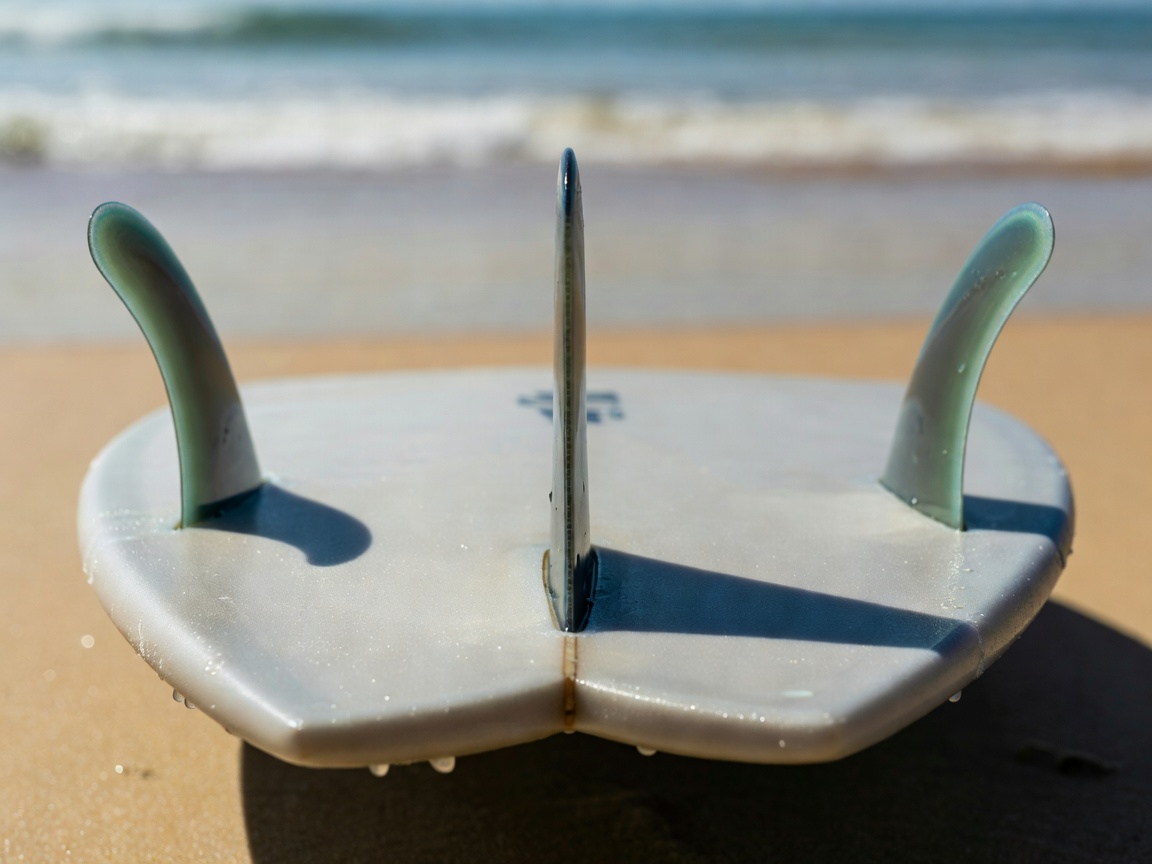
How a shortboard feels under your feet
Stand on a modern thruster and the first thing you notice is how little of it there is. Most performance shortboards sit between 5'8" and 6'4", with a pulled-in nose, a narrow tail and somewhere around 24 to 32 litres of foam for an average adult. That missing volume is the point. Less foam means the board settles a touch under your back foot, so the rail engages the moment you shift weight and turns come from the hips rather than the arms.
Rocker does the rest. A performance board carries plenty of nose lift to stop it pearling on late, steep take-offs, and a fair amount of tail kick to let it pivot in the pocket. The trade-off is speed on flat sections: a heavily rockered board pushes water, so it needs a wave with some push behind it. That's why the same board that sings at a punchy reef can feel sticky and slow at a crumbly beach on a weak day.
The three-fin layout most surfers know came from Australian shaper Simon Anderson, who introduced his Thruster in 1980 and proved it by winning at Bells Beach the following year. Four decades on, almost every performance shortboard still starts from that template.
Choose your level
Should you ride one yet?
Not yet, and that's fine. A shortboard punishes exactly the skills you're still building: paddle fitness, wave reading and a quick pop-up. You'll catch a fraction of the waves you would on a foam mid-length, and those waves are where the learning happens. Spend your first season or two on 7'0" to 8'0" of generous volume, then come back to this page once you're making the wall and turning on purpose.
This is where most people buy too small. If you can generate speed down the line and do a basic bottom turn, look at a hybrid or groveller before a pro model. Boards like the Channel Islands Happy Everyday, the Lost Puddle Jumper or the Haydenshapes Hypto Krypto keep width forward, flatten the rocker and add a few litres so you keep catching waves while learning to turn harder. A rough starting point: your weight in kilograms multiplied by 0.40 to 0.48 gives a sensible volume in litres.
Once you're surfing critical sections and linking turns, a true performance board earns its place. Models like the Pyzel Ghost, the JS Monsta and the Lost Driver are built for good waves and committed riders. Expect volume around 0.34 to 0.38 litres per kilo, then adjust: go up a litre or two if you mostly surf weak beach breaks, or if paddling matters more to you than it used to.
Shortboard families by the numbers
Lengths and volumes below assume a rider of around 70 to 80 kg. Lighter surfers can shift down, heavier surfers up.
| Family | Typical length | Volume range | Best waves |
|---|---|---|---|
| Performance thruster | 5'8"–6'4" | 24–32 L | Chest to overhead, punchy, hollow |
| Hybrid / everyday | 5'6"–6'2" | 28–38 L | Waist to head-high, mixed conditions |
| Groveller | 5'2"–5'10" | 28–38 L | Knee to chest, soft and mushy |
| Twin-fin fish | 5'2"–6'0" | 28–40 L | Small to mid, open faces |
| Step-up | 6'4"–7'0" | 30–40 L | Overhead, powerful, long walls |
On our rack right now
These are boards we've ridden across real sessions, not showroom impressions. Each one gets a single honest line about how it feels.
- Channel Islands Happy Everyday (Britt Merrick): loose but forgiving, the best one-board answer we've found for average surf.
- Pyzel Ghost (Jon Pyzel): drives hard off the bottom and wants waves with real power behind them.
- Lost Driver (Matt Biolos): classic high-performance feel, quick rail to rail, rewards precise footwork.
- JS Monsta (Jason Stevenson): a little extra foam under the chest makes paddling into waves easier than it looks.
- Firewire Seaside (Rob Machado): a quad fish that flies down the line on weak days and makes everyone grin.
Construction changes the feel too. Traditional PU/PE boards have a damp, familiar flex; epoxy and EPS builds float higher, feel livelier and resist pressure dings better, but can chatter in choppy water.
Pros and cons of riding short
Pros
- Turns fast and tight in the pocket
- Duck-dives easily under closeouts
- Fits critical, late take-offs
- Light, easy to carry and travel with
Cons
- Catches fewer waves, especially small ones
- Punishes weak paddling and slow pop-ups
- PU builds ding and buckle more easily
- The wrong size can stall your progress for a season
Our honest advice: ride the board that catches you the most waves you can actually surf well. Ego litres are the most expensive litres in surfing.